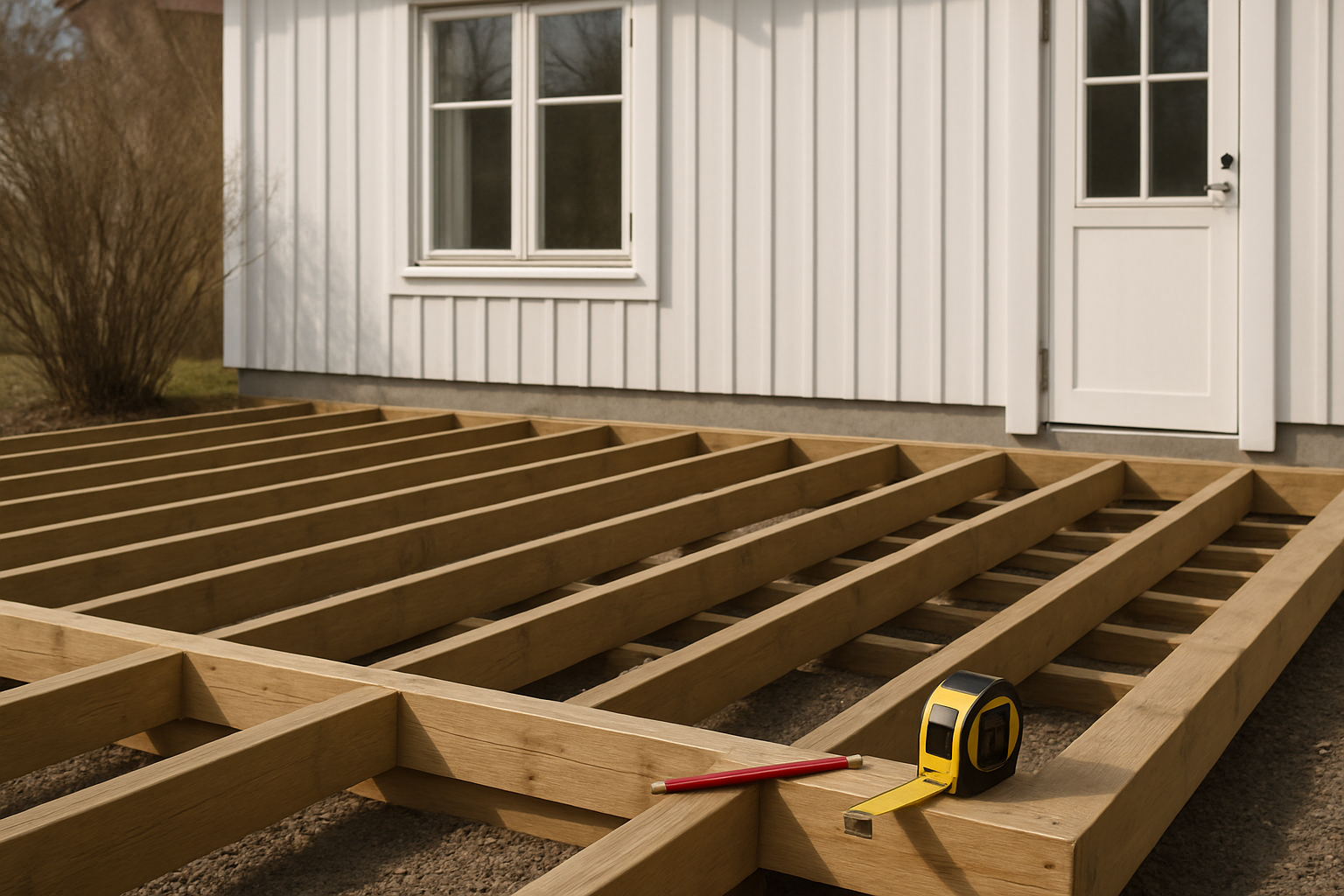
When people plan a new deck, they often focus first on the deck boards. But the framing underneath matters just as much. The right joist spacing helps the deck feel solid, hold its shape better, and give the boards the support they need over time.
There is no single spacing rule that fits every project. The right layout depends on board thickness, board material, installation pattern, and how much load the deck needs to handle. Still, a few practical rules of thumb can make the planning stage much easier.
What does joist spacing mean?
Joist spacing usually means the distance from the center of one joist to the center of the next. In US deck-building language, that is the on-center spacing. This measurement plays a big role in how well the deck boards are supported.
For many standard wood deck builds using boards in the roughly 21-28 mm range, about 7/8 to 1 1/8 inch, a starting point around 16 to 24 inches on center can work depending on the board and the manufacturer guidance. If you are using thinner boards, composite decking, or a diagonal pattern, tighter spacing is often the safer choice.
A practical starting point for wood decking
- About 24 inches on center: can work for simpler deck layouts with solid wood boards and normal loads if the board manufacturer allows it.
- About 16 inches on center: is often a safer choice if you want a stiffer deck surface with less bounce.
- Tighter than 16 inches on center: is often worth considering for diagonal layouts, composite boards, heavy outdoor furniture, or sections with higher loads.
If you are unsure, slightly tighter spacing is usually the smarter decision. It may cost a little more in framing material, but it often gives you a deck that feels better underfoot and lasts longer.
When should you reduce the spacing?
Some projects call for a tighter framing layout than a basic deck.
- You are using thinner deck boards.
- You are installing the boards diagonally or in a layout that increases the span.
- The deck will include an outdoor kitchen, hot tub, large planters, or other concentrated loads.
- You are building with composite decking, which often has stricter support requirements than pressure-treated wood.
The more demanding the project is, the more important it is to check the installation guide for the exact materials you plan to use. That includes the decking itself, any hidden fasteners, and any system-specific substructure parts.
Plan the framing before you order materials
- Start with the decking: confirm the board thickness, width, and manufacturer recommendations before you settle on the framing layout.
- Think about board direction: changing the board pattern can change the recommended joist spacing.
- Plan seams and transitions: where boards meet, you often need extra support or double joists.
- Remember airflow and drainage: good framing is not only about strength. It also helps keep the structure drier over time.
It is also worth checking that your footings and framing are level before you install the deck boards. Small errors in the framing become much more visible once the deck surface is finished.
Common mistakes that lead to bounce and uneven decking
- spacing the joists too far apart for the board type
- not adding enough support at seams and edges
- skipping level checks before the deck boards go down
- leaving the top of the joists exposed to moisture without protection
Many of these problems show up later, after the boards start flexing, twisting, or holding moisture. That is why it pays to spend a little more time on the framing before you move on to the deck surface.
Use the calculator before you order deck boards
Once you know how the framing will be built, the next step is to estimate how much decking and how many screws you need. The deck calculator gives you a quick planning baseline before you buy materials.
It can also help to read deck framing basics: building a stable base and deck building: a simple guide to getting started before you start.